Concordia University closed due to ‘the threat of extreme disruption.’
Mitchell Consky | The Canadian Jewish News | October 9, 2025
The second anniversary of the Oct. 7 Hamas-led terrorist attack on Israel was marked by vigils, protests and heated confrontations that Jewish students say left them feeling unprotected on their own campuses, while administrators issued statements about safety and free expression.
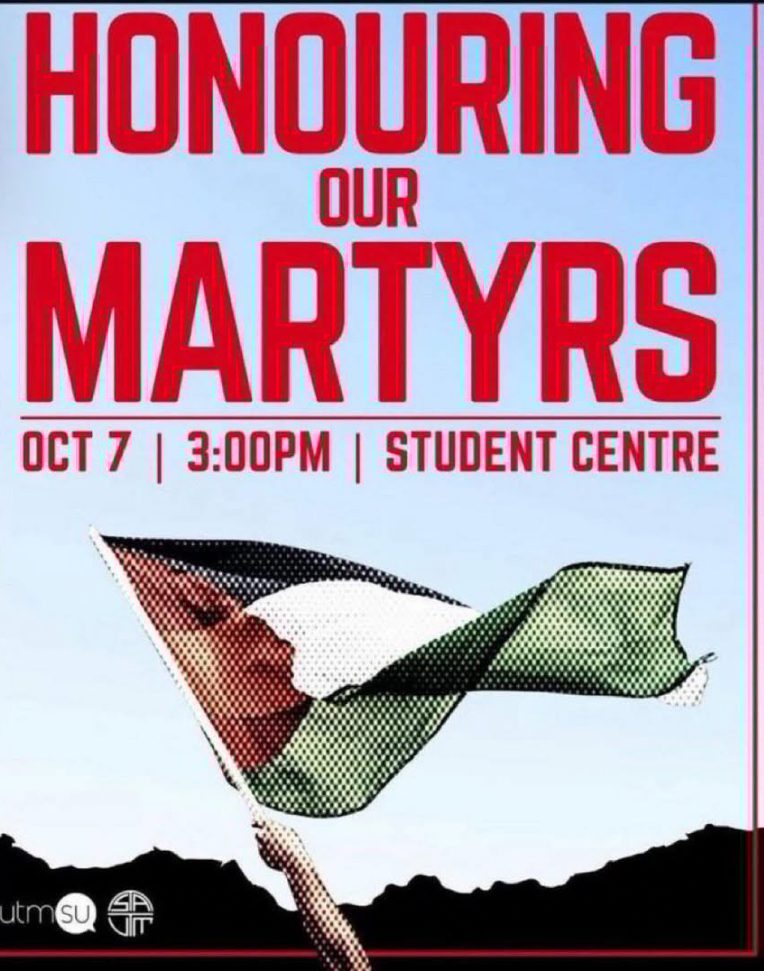
In Montreal, one university pre-emptively shut down its downtown campus. At the University of Toronto’s Mississauga campus, a vigil honouring Palestinian ‘martyrs’ ended with Jewish students being escorted out a back door. In Toronto, a high school’s decision to play O Canada in Arabic on Oct. 7 earned a rebuke from Ontario’s education minister.
StandWithUs Canada called Oct. 7 “a challenging day for Jewish and pro-Israel students,” saying many “fell victim to targeted harassment from antisemitic protesters” as they tried to mark the anniversary by displaying hostage photos and Israeli flags.
Montreal: Concordia closes, McGill sees flag burning and police warnings
In Montreal, Concordia University took the extraordinary step of closing its downtown Sir George Williams campus on Oct. 7, citing “the threat of extreme disruption.”
In a letter to students, vice-president and vice-chancellor Graham Carr said the decision was made “to protect our entire community” after two non-students were arrested the previous day—one allegedly carrying “a metal bar and several incendiary devices.”
“With hundreds of protesters from other universities and CEGEPs expected, as well as counter-protesters not linked to the university planning to gather outside our downtown campus this afternoon,” Carr wrote, “the threat of extreme disruption is simply too high to operate as usual. Acts of intimidation and violence have no place in our society.”
Concordia’s communications office had already reminded students that violence would not be tolerated and that those who wished to attend classes should be able to do so “without disruption or harassment.” But for many Jewish students, the shutdown felt like capitulation.
“It really scared many normal students who just want to go to class,” said Anastasia Zorchinsky, founder and co-president of the Startup Nation Concordia chapter. “It shows the university is giving in to the violence.”
Hundreds of officers—more than 600, according to Montreal police—patrolled the downtown core, sealing off sections of Ste-Catherine Street.
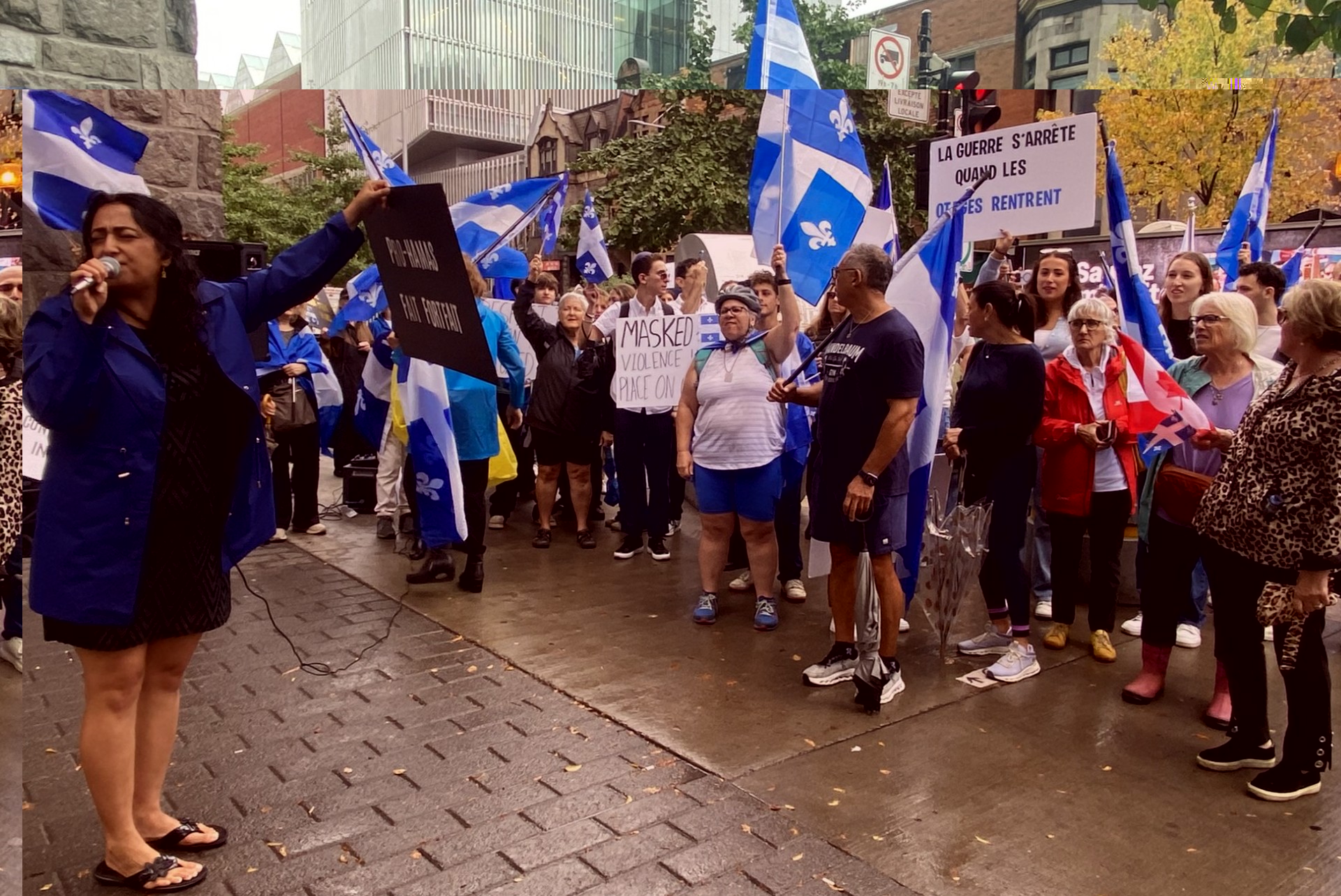
Outside Concordia’s Hall Building, about 80 counter-demonstrators, including Jewish Montrealers, Quebec nationalists and students from both Concordia and McGill, rallied in support of Israel before marching east toward McGill behind a billboard truck streaming images from the Oct. 7 massacre and other global atrocities.
At McGill University, which remained open but under restricted access, tensions escalated quickly. Several hundred pro-Palestinian demonstrators pushed through security gates to occupy the main lawn, setting off smoke bombs and ignoring police orders to disperse.
Zorchinsky who visited McGill, said she saw “fireworks in the middle of campus” and “a bloody Israeli flag” being burned on the ground. “It was just unbelievable and the police did nothing,” she told The CJN.
When a Jewish student unfurled an Israeli flag nearby, she said, police confronted him. “They said, ‘You’re going to get arrested if you don’t leave now,’” she recalled. “Then a few other students got their Israeli flags out and police came to us. They said it’s an order, you must leave now. We’re not negotiating.” Officers then physically escorted them off campus.
She described the experience as “unbelievable,” adding, “in that moment I understood that things are much worse than before.”
A Quebec Superior Court judge had denied McGill’s request weeks earlier for an injunction to restrict campus protests, finding that while evidence of antisemitic incidents was “extremely troubling,” the proposed order would not prevent future harm and could infringe on free expression.
McGill said it had “enhanced campus security measures” and that “academic activities will proceed as planned.”
Students such as Drew Sylver, who attends Concordia, said those promises rang hollow. “Statements are great, but action is what’s needed,” he told The CJN on Oct. 6. “Without visible consequences, the scene just repeats.”
Mississauga: Jewish vigil ends in confrontation
At the University of Toronto Mississauga (UTM), Jewish students gathered for a small vigil to commemorate victims of the Oct. 7 massacre. Hillel Ontario and StandWithUs Canada said the group was surrounded by demonstrators and escorted out a back door by security, calling it “a disgrace that, on the anniversary of the worst mass murder of Jews since the Shoah, Jewish students had to be escorted out a back door to protect them from an angry mob.”
The organizations described the event as “a moral failure and an institutional disgrace,” urging UTM to “immediately and unequivocally condemn this hateful mob and take action to hold those responsible accountable.”
A spokesperson for the University of Toronto confirmed with The CJN that these incidents occurred at separate areas of the Mississauga campus, explaining that the UTM Student Union gathered at a campus pub while the Jewish Student Association congregated in a separate university building.
“We are aware of an incident that took place on Tuesday at the University of Toronto Mississauga affecting members of the UTM Jewish Student Association,” the spokesperson said. “We take this matter seriously and are gathering more information. All members of the university community have a right to learn, live, work, and research in an environment that is free of discrimination and harassment. If we determine there have been violations of university policies, we will take appropriate action.”
Toronto: anthem in Arabic on Oct. 7 prompts outrage
In Toronto, controversy erupted at Earl Haig Secondary School, where the morning broadcast of O Canada was played in Arabic. In an email statement, a Grade 12 student at Earl Haig told The CJN the anthem was followed by an announcement recognizing Islamic Heritage Month, and that the principal’s later message urging kindness made no mention of Jews, Israel or the Oct. 7 anniversary.
“Many students and parents felt this was incredibly insensitive,” the student wrote in an email statement. “Our administration has continued to ignore Jewish and Israeli voices—this being yet another example.”
StandWithUs Canada said the decision “begs questions at the very least about the school’s sensitivities, and at worst, about an intentional desire to isolate and discriminate against Jewish students.” The group described the timing—on the day marking “the deadliest attack on Jews since the Holocaust”—as “a coincidence too uncanny to ignore.”
Ontario Education Minister Paul Calandra criticized the move on X, writing that he was “disappointed that I would have to direct school boards [to] demonstrate appropriate respect for our National Anthem by ensuring that it is played only in its official form.” He said the incident “underscores that school boards should be focused on creating safe learning environments for all students, never at the expense of one community over another.”
In a letter sent to parents of students at Earl Haig on Oct. 9, the school’s principal Steve Yee wrote that he carried out an internal investigation.
“After speaking with multiple students and staff throughout the week, including those who are part of the Earl Haig Radio Team, we can now say with certainty that this was not done with ill-intent and that they are truly remorseful for what happened,” Yee wrote. “That being said, I recognize the hurt playing this version of the anthem on this date caused those in our community, and we are deeply sorry for this.”
Legal push: Tafsik files complaints over Oct. 7 incidents
Tafsik, a Jewish civil-rights organization that describes itself as a grassroots network combatting antisemitism and hate crimes in Canada, responded to the day’s events by announcing a wave of legal complaints to the Human Rights Tribunal of Ontario.
The filings name several institutions, including Earl Haig Secondary School, the University of Toronto, and multiple school boards and student unions.
“Yesterday was a brutal day for our community,” the organization said. “The horror of the October 7th massacre still hangs over us … but it wasn’t just the memory of that bloodshed that left us reeling. It was the sickening reality that once again, universities, schools, and unions chose to rally against us.”
Tafsik vowed to pursue accountability “with maximum intensity,” declaring that “Jewish safety and dignity are non-negotiable.” It also warned that individuals who incite hate or issue threats online would face “real, legal, expensive, and lasting consequences.”
‘Campus is unsafe’
By the end of the day, downtown Montreal remained under heavy police watch, and McGill’s lawns were littered with protest debris.
For Zorchinsky, who watched police push back Jewish students for displaying Israeli flags at McGill, the anniversary reinforced a grim pattern. “Campus is unsafe,” she said. “We all have to go there every single day, and the university itself should be changing that. Not us.”
She and others say they want more than symbolic gestures—they want consistent enforcement. “Without consequences, statements mean nothing,” Zorchinsky said.
The story has been updated to include comment from University of Toronto and the Earl Haig principal Steve Yee.
With files from Joel Ceausu
Read the full article here.